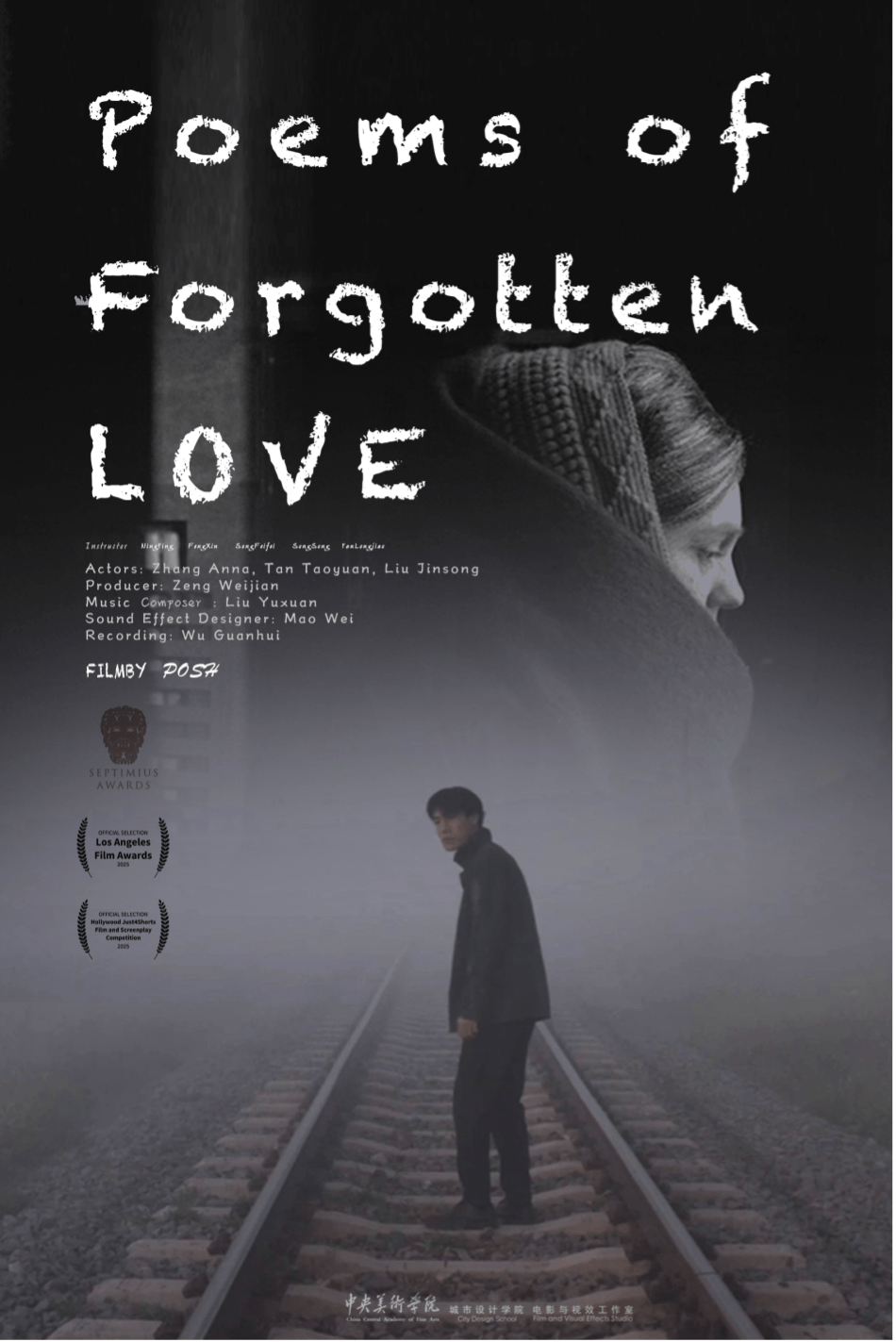
LA Film Awards Best Score Winner
Host by Ziyuan Yue
A link to watch the whole film: https://filmfreeway.com/projects/3406266
Recently, we sit down with composer Yuxuan Liu, winner of Best Score at the LA Film Awards, to explore the creative journey behind his award-winning work on The Forgotten Love Poem.
In this conversation, Liu reflects on the evolution of his artistic philosophy, the challenges of collaborating across cultures and disciplines, and the development of his self-described “experiential composition” method—an approach rooted in emotional immersion and narrative understanding.
From creative breakthroughs to moments of self-doubt, this interview offers an honest look into the process of becoming not just a music producer, but a storyteller through sound.
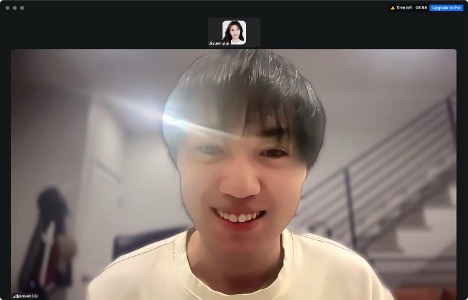
Q: Congratulations on the award! Could you start by introducing yourself?
Yuxuan Liu:
Hello everyone, my name is Yuxuan Liu. I am a composer working primarily in film, game, and concert music.
I moved to Los Angeles two years ago to pursue a Master’s degree in Film Scoring at LACM, and I have been living in Los Angeles for nearly two years now.
Q: Could you tell us about the award-winning project? What kind of film is it, and what story does it tell?
Yuxuan Liu:
This is a short film titled The Forgotten Love Poem. The project began around early 2024.
The director, Posh, is a friend of mine from China. He graduated from the Central Academy of Fine Arts, majoring in filmmaking, and this project was actually his undergraduate thesis film. I became involved because I had previously composed music for some of his classmates, so he was introduced to me through mutual connections.
The story follows an elderly woman who comes to a church to confess. She seeks confession because, in her youth, she had an affair with her husband’s close friend. Although many years have passed, she has never truly been able to forget. In her later years, she returns to the church, hoping to confront and release the memories she has carried for so long.
Visually, the director is deeply inspired by the works of Andrei Tarkovsky,
so the film adopts a poetic, auteur-driven visual style.
Musically, because the story carries elements of Russian cultural atmosphere, the director hoped the score would evoke a sense similar to Orthodox church music—something sacred and solemn.
In terms of sonic character, I aimed for a more monumental and spacious sound. However, from a narrative perspective, the core of the music revolves around the theme of “confession,” so the overall approach remains highly narrative-driven.
Q: You mentioned this project began earlier—how long was the scoring process, and what were the main challenges you encountered?
Yuxuan Liu:
The project actually started quite early, around April or May of 2024. The director initially hoped to complete a version of the score before the graduation screening in June. However, the first version I wrote for the opening did not achieve the desired result, so the project was temporarily put aside.
Later in the second half of 2024, I began dedicating more time to refining the music, and the project was finally completed in early 2025. In reality, the truly efficient composing time was less than one month. However, we spent a significant amount of time aligning creative concepts and adjusting how we communicated.
At the beginning, I approached the project using a standard commercial workflow: the director would provide references, I would compose based on them, then wait for feedback—what needed changing, what instruments to use and revise accordingly.
For commercial projects, this workflow is very efficient. But I soon realized that in artistic creation, this method simply did not work. No matter how many revisions I made, the results never felt right. At one point, despite a 16-hour time difference, the director scheduled a long call with me that lasted three to four hours. During that conversation, he gave me very direct criticism. He said: “You are an excellent music producer, but not a composer.” He explained that if I only followed instructions mechanically, then AI could completely replace that role. He did not need someone who merely executed tasks, he needed a creative partner who truly understood the film.
That statement was extremely sharp and deeply impactful. It fundamentally changed my creative approach. In fact, I had already been thinking about similar questions for a long time about what composition truly means, but I had not yet found a stable solution. Our discussions accelerated that realization.
Q: You mentioned that the traditional client-service model didn’t work for artistic collaboration. What kind of working method did you and the director eventually develop?
Yuxuan Liu:
The key understanding we reached was this:
a composer and director should be collaborators on equal footing—not in a hierarchy of command and obedience.
The director is not a musician, so he cannot always articulate precise technical musical requirements. What he can express are abstract emotions—words like “confession,” “resentment,” and “love”—as well as the emotional core of the story.
If I focused too much on asking for technical instructions, I would never reach the heart of the problem, because my attention would be on technical details rather than the story itself or rather, on the director as a person rather than the narrative. The correct approach, I realized, was to first immerse myself deeply in the story—to feel the film, the characters, and the cinematic language. When I placed myself inside the character’s experience, the music naturally began to form in my mind.
When I started proposing musical ideas rooted in the story itself, communication suddenly became much more efficient and natural. I jokingly call this method “Experiential Composition.” I believe this also represents respect for the director’s work. Every shot, color grade, and edit is carefully designed. As composers, we must cherish and understand those details if we want to be true film composers, not merely people who write pleasant melodies as tools.
Q: You mentioned your idea of “Experiential Composition.” Could you explain what that method looks like in practice?
Yuxuan Liu:
This method is something I developed over the course of an entire year through continuous reflection and experimentation. It is somewhat similar to method acting, but applied to music composition. Simply put, it means completely immersing oneself in the story—entering the character’s life and emotional world. Instead of “performing” emotions through technical tricks, the goal is to truly feel and experience them.
For example, in The Forgotten Love Poem, the protagonist spends her entire life entangled in love, resentment, guilt, and longing toward her husband. When I compose, I do not begin by thinking about theory, modes, or harmony. Instead, I place myself in the role of the elderly woman, imagining decades of loneliness, her confession inside the church, and the complicated emotions she holds toward her husband.
When I become fully immersed in that emotional state, the notes begin to flow naturally.
I remember one night at around 2 a.m., I improvised a short twenty-second piano melody based purely on emotion and sent it to the director. He became extremely excited after hearing it and sent multiple messages saying, “This is exactly the sound I was looking for.”
This method has no fixed formula, and it is impossible to predict the final result in advance. Sometimes, after finishing, even I feel like I am listening to someone else’s work. That uncertainty makes every creative process fresh and exciting, because you never know what the final piece will become at the beginning. However, the downside is that it is emotionally exhausting. I sometimes describe the aftermath as a kind of “post-creation depression,” where I need time to detach and recover.
But this approach produces music that AI can never truly replace music with life in it. Human experience is unique. AI has no lived experience, no real emotions, and no genuine memories, at least not yet. Even if it someday develops something similar, it would still be another kind of “person,” not a replacement for our own experiences.
Q: Does experiential composition require strong technical foundations? What is the relationship between technique and experience?
Yuxuan Liu:
Experience is the soul, and technique is the skeleton. Both are indispensable.
Experiential composition is not about writing randomly based on feelings. It must be supported by solid compositional technique. When I am immersed in an emotional state, I can instinctively sense when something is not right, such as when a melody feels wrong or when a certain mode does not match the character. At that point, technique becomes the tool I use to refine the music, such as changing modes, adjusting orchestration, or reshaping harmony, rather than relying on blind trial and error.
However, I do not believe one must master every technique before starting to compose. A film director does not wait until learning every possible filming method before making movies. We can begin with experience at the core, create actively, and then identify technical gaps along the way and improve them step by step.
This kind of growth is a long-term accumulation rooted in creative practice, rather than an efficiency-driven competition like commercial production. In the age of AI, I believe pure technical efficiency alone offers limited long-term competitiveness. But experience-based creativity will continue to deepen with life experience, aesthetic growth, and emotional maturity. That is also why artists often become more valuable as they grow older.
Q: Looking back at the score for this film, are there any musical ideas or designs you are particularly proud of?
Yuxuan Liu:
One of the elements I am most proud of is the use of the traditional Xinjiang instrument Satar, which was recorded by my performer friend Wang Jie in China. The Satar has a very distinctive timbre with rich high-frequency overtones, which helped vividly portray the protagonist’s inner conflict and sense of confession. In addition to that, I created many original sound elements specifically for the film.
First, I recorded sounds such as tearing paper, crumpling paper, and striking paper. Since the film is titled The Forgotten Love Poem, and the relationship between the protagonist and her husband relies heavily on letters, paper becomes an important symbolic element in the story.
Second, I designed rhythmic material inspired by Morse code. The story takes place during a turbulent period in the 1960s, when telegraphs were an essential form of communication. I extracted the protagonist’s initials, P and A, converted them into Morse code rhythms, and embedded those rhythmic patterns into the piano and string writing. These hidden rhythmic motifs symbolized her longing and anticipation for news from her husband.
Q: How did you feel when you learned that you had won Best Score at the LA Film Awards? What impact has this award had on your career and mindset?
Yuxuan Liu:
To be honest, when I found out I had won the award, I felt surprisingly calm. For me, this recognition is only a milestone, while the transformation of my creative philosophy and the discovery of my own artistic path are far more important than the award itself. Before this, I often felt anxious about how to keep improving, how to find work, and how to make a living. I tended to mix artistic creation with financial survival, which created a lot of pressure. Now, I feel much more at peace. I have found a creative method that I believe I can rely on for the rest of my life, and I no longer feel anxious about pursuing music as a career.
Of course, this award is also a valuable starting point. It allows more people to see my work and helps build trust for future collaborations.
Q: For students and young composers who are still studying or hoping to enter the film scoring industry, what advice would you give them?
Yuxuan Liu:
Based on my own experience when I first came to the United States, I would offer three practical suggestions.
First, language is extremely important.
We should actively integrate into the environment and avoid limiting ourselves to only interacting within our own cultural circles. Communicating with local students and creators is essential. Language is not just a communication tool. It is also a way to understand culture and the deeper meaning behind films.
Second, treat every assignment as portfolio material.
Do not think of school projects as just homework. Approach them with the mindset that they should be polished to the level of portfolio pieces that can be submitted for jobs or competitions. Film scoring is a highly practice-driven field, and strong work often speaks louder than academic credentials.
Third, be proactive in networking and maintain visibility.
Do not be shy in social settings. Introduce yourself to directors, producers, and fellow creatives. Continue sharing your creative work and progress whenever possible. Even if opportunities do not appear immediately, when the right project comes along in the future, people are more likely to remember you.
At the same time, it is important to remain humble, but never diminish your own value. Maintain professionalism and let your work speak for itself.
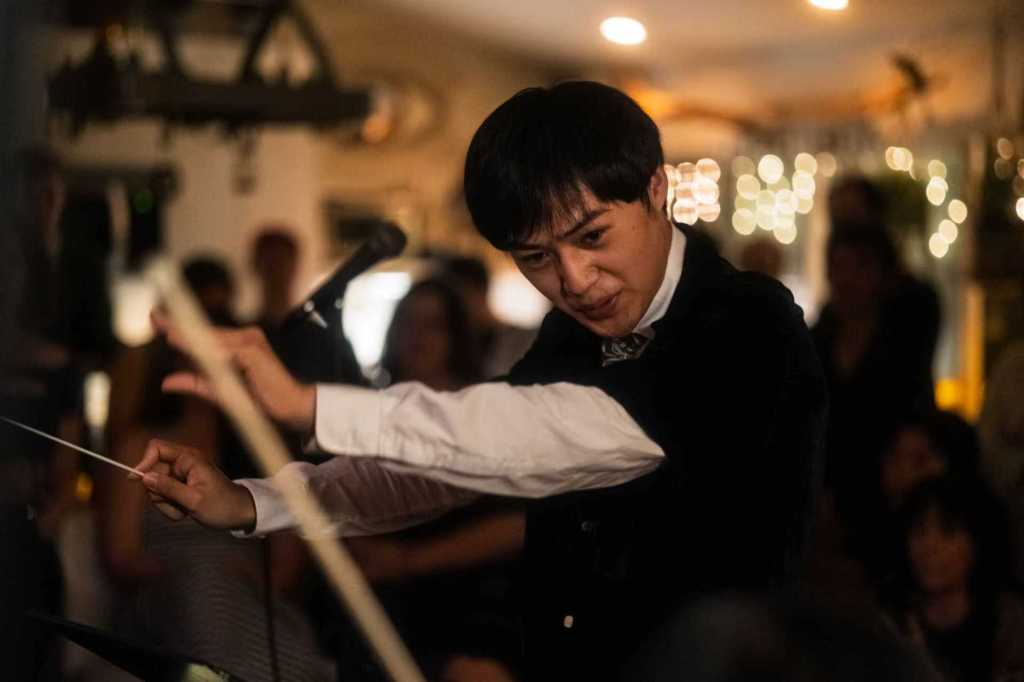
Through this conversation, Yuxuan Liu reflects on the balance between technique and lived experience, the importance of genuine collaboration, and the value of developing a personal creative philosophy. His journey reminds us that film scoring is not only about sound, but about understanding stories, emotions, and the human experience behind them.
Follow Yuxuan Liu on Instagram:
https://www.instagram.com/yuxuanliumusic
Designed with WordPress
 Chinese Composer Community
Leave a comment